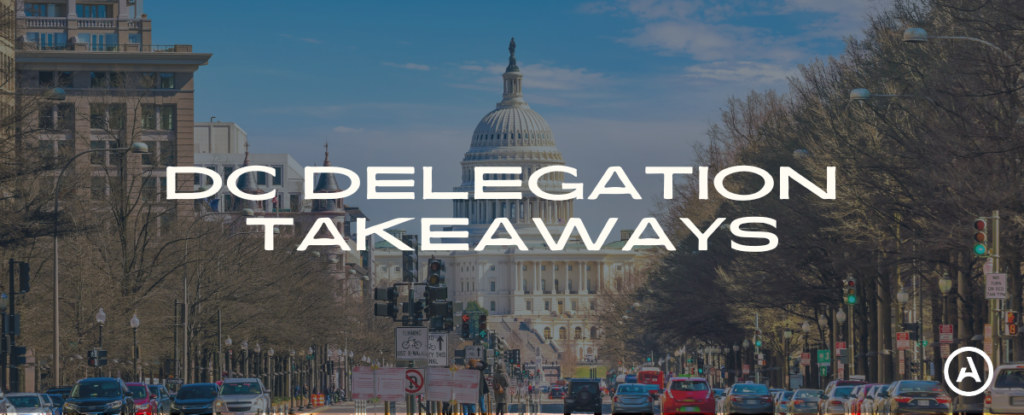
This year’s Alder DC Delegation covered a number of issues that are important to our community and the world. Here are some quick-hit takeaways from the speakers and experiences we had …
Night 1: Power in the Beltway
At Old Ebbitt, we heard from Brody Mullins, Pulitzer Prize-winning journalist and author of The Wolves of K Street. Here are some of the key takeaways he shared from his years of reporting on the town’s most influential players:
- Companies and interests are often incentivized to undermine their competitors to get an advantage in DC.
- Elected officials usually have one goal: to get re-elected.
- Money talks, but the constituents’ needs are king, as we learned in the case of former House Majority Leader Eric Cantor.
Day 2: Keeping our Nation Safe
General Walt Piatt
This was a jam-packed day, starting with a conversation with General Walt Piatt, who now leads the Wounded Warriors Organization. He brought deeply human stories of those who fight for our freedom and how we can serve them. A few important lessons:
- Always thank veterans for their service – acknowledgment is important, even if it feels uncomfortable.
- Embracing mindfulness can not only improve our ability to make decisions, it can quite literally save lives.
- By deepening our understanding of the things we share with those we disagree with, we create important opportunities to advance our national interests.
The CIA with Associate Director Dan Caine
Everybody loves knowing a good secret, and we learned a lot on this special visit. But we also got an amazing opportunity to learn about the way that this clandestine agency operates and walked away with some valuable perspectives:
- Sometimes, glory lies in the boring stuff: Associate Director Dan Caine revealed that to operate at his best for the agency, it’s essential to prioritize sleep and exercise.
- The men and women of the CIA are unsung heroes whose work lives in the shadows. When they come home from duty, there aren’t parades or fanfare.
- It takes people with all kinds of skills to gather and process intelligence, from spies to bug experts.
Spy Museum Dinner with Ralph Goff
Ralph Goff is a longtime friend of the Alder community. At this special dinner overlooking the DC skyline, we brought together some of the things we learned earlier in the day and contextualized them against his experience in the conflicts simmering around the world:
- On Russia and Ukraine, he shared that Putin is simply not a figure that can be reasoned with, and the U.S. must be committed to Ukraine’s freedom.
- On Israel and the Middle East, he revealed that he saw threats leading up to October 7, but that even Iran was probably surprised by what Hamas and the Islamic Jihad pulled off that day.
- Our enemies are always watching what we’re doing, perhaps more so than even we are.
Day 3: Policy and Advocacy
John Hillen
Before going to Capitol Hill, we had a conversation with John Hillen, a business exec, diplomat, and public affairs expert to understand some of the issues lawmakers are paying attention to. We learned several important things …
- Balancing political pressures with national security interests requires well-developed strategic decision-making tactics.
- Most of our world’s democracies are less than a generation old – a reminder that when dealing with people from other places, it’s important to understand that this whole “self-determination” thing is fairly new to them.
- The Founding Fathers imparted a lot of wisdom in our Constitution but we are straying from their intentions for our society.
Congressman Vince Fong
We started our afternoon on the Hill at the legendary institution Hawk ‘n’ Dove and were visited by one of the newest members of the House, Congressman Vince Fong. Though he’s new to Congress, he’s got a long track record of service to Californians, and shared some of his priorities …
- Game respects game – although he’s new to Congress he’s developed deep relationships through his predecessors that he’s leveraging to build influence.
- Some of the most consequential stories are the most underreported ones. While the media has been focused on the campaigns, the port strike on the East Coast threatens commerce across the country.
- Leaders like those in our community are essential to supporting people’s journeys to public service.
The United States Capitol
To be able to walk into the halls where our government operates is special no matter how many times you’ve done it. This was the more historical, “touristy” part of our delegation, but a few highlights included:
- Seeing the old Senate chambers.
- Sitting on the floor of the House hearing about its history from Congressman Bryan Steil. It’s smaller than it looks on TV during the State of the Union!
- Looking over the city from the Speaker’s Balcony.
Congressman David Valadao
The future of California isn’t in its big cities – it’s in places like the Central Valley, where Congressman Valadao serves. The issues there don’t make the front pages of national newspapers (ahem, San Francisco), but they drive our nation more than most realize …
- Water rights are critical here and have national implications given the region’s booming agricultural production.
- All politics is local – the partisan registration of the district leans Democratic, however rising costs create a stranglehold on the working class, and so they support whoever puts their needs first.
- Life in places like the Central Valley is different than in Washington or Sacramento, and often policymakers forget the impact their decisions have on communities like these.
John Bailey
One of the biggest questions lawmakers are grappling with in the tech space is how to regulate and utilize Artificial Intelligence to advance our national interest. John Bailey, an AI expert, and Senior Fellow at AEI helped us understand …
- The developers of AI platforms don’t totally understand how the technology gets from point A – the inputs we feed it – to point b, the final content it delivers.
- The U.S. should be working on “friendshoring” critical tech production to reduce our dependence on geopolitical foes like China.
- Private sector leaders and lawmakers alike are working to understand the ways that this technology can be used to harm American interests.
General John Mulholland
Across the river in Old Town Alexandria, we enjoyed a dinner conversation with retired 3-star General John Mulholland and special guest, Ohio Secretary of State and green beret veteran Frank LaRose. Our discussion focused on Major General Mulholland and how he revolutionized warfare by empowering his troops to operate with greater autonomy after 9/11.
- Special Operators as Elite Leaders: LTG(R) John Mulholland emphasized that Special Operators are elite warriors defined by quiet professionalism, adaptability, and a mission-first mentality. They thrive in ambiguous environments, achieving the impossible while embodying service and discipline.
- Evolving Masculinity and Leadership: Mulholland highlighted that modern masculinity in Special Operations requires both resilience and emotional intelligence, where empathy is as crucial as strength. Leadership is best expressed through service, as great leaders earn power by enabling those they command.
- America’s Strength and Leadership in Crisis: Mulholland asserted that America’s superpower status stems from its values and commitment to doing what’s right, not just military might. Reflecting on his leadership after 9/11, he stressed that in crises, clarity and decisiveness are paramount for effective leadership.
Day 4: Victims of Communism
At the Victims of Communism Museum, we were given a tour by their President and CEO Dr. Eric Patterson. He helped us understand the different ways totalitarians throughout the world have used communism to oppress millions …
- A stunning number of people have lived under the yoke of communism and continue to do so today.
- Their Venezuela Exhibit told powerful stories of young people ripped from their families for exercising free speech.
- In the standing exhibits, we learned about the ways that communist regimes throughout history manipulated the truth to create propaganda to cover their oppression.